Home › Industrial Floors and Specialty Slabs
We install industrial concrete floors and specialty slabs in Buffalo, NY that are engineered for high loads, traffic, and specific industry needs. From superflat warehouse slabs to cold storage and food grade floors, we coordinate mix design, reinforcement, and finishing to meet performance specs. Your industrial concrete floor will be built for long term duty.
Superior Concrete Buffalo provides professional industrial concrete floor throughout Buffalo, NY, New York and the surrounding area. Our licensed, insured crew delivers safe, clean, on-time work with a free estimate before anything begins. Call (716) 303-4131 or request your free quote.
Industrial Concrete Floors Built for Buffalo Workloads
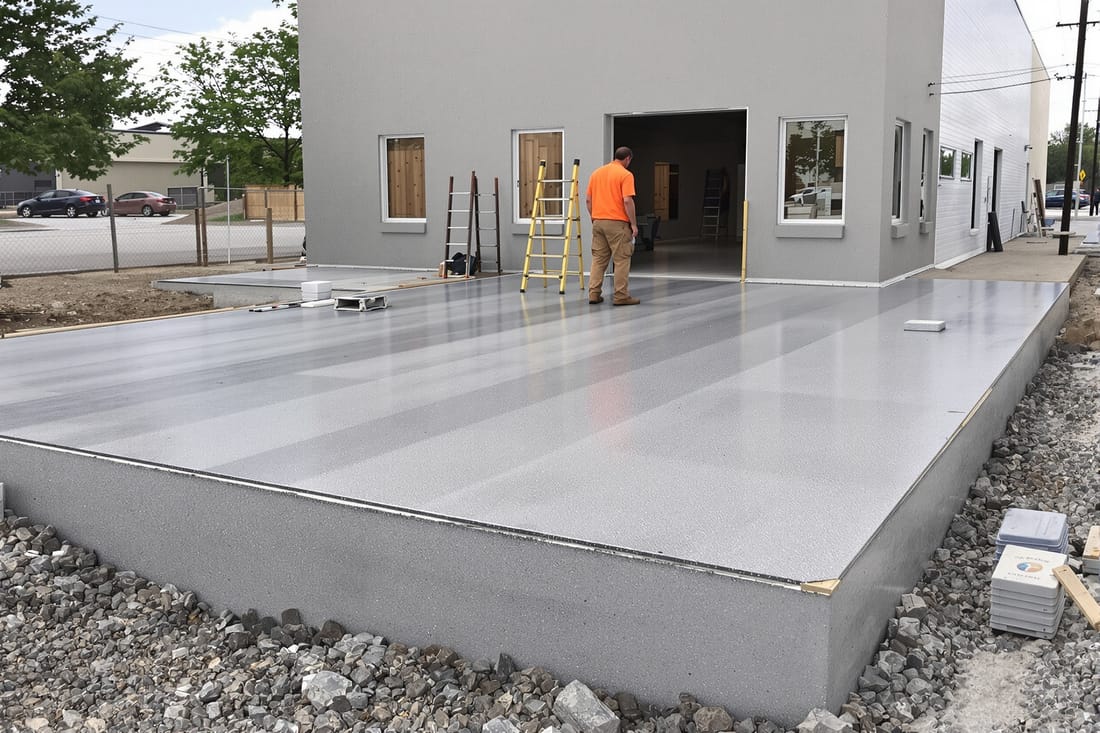
Industrial concrete floors in Buffalo have to handle more than just foot traffic. They carry forklifts loaded with pallets, chemical spills, freeze-thaw cycles, and constant impact from daily operations. Superior Concrete Buffalo designs each industrial concrete floor around the specific loads, equipment, and environment of your facility, not a generic warehouse somewhere else.
We start by walking your space: manufacturing bays on South Park Avenue, cold storage near the waterfront, logistics centers in Cheektowaga, or older industrial buildings on the East Side converted to light manufacturing. We document racking layouts, forklift paths, dock locations, trench drains, and any existing slab failures. That field information drives the slab thickness, reinforcement method, joint layout, and surface treatment so the finished floor actually fits how your operation runs.
Our specialty slabs range from heavy-duty forklift aisles and machine pads to freezer floor slabs, high-flatness racking aisles, and slabs over poor existing subgrades in older Buffalo properties. We design for the real Buffalo climate, heavy snow loads tracked in on tires, rock salt exposure at loading docks, and wide temperature swings in buildings that may not be fully conditioned.
How We Engineer Industrial Floors for Heavy Loads
For a true industrial concrete floor, guessing at slab thickness is not acceptable. Superior Concrete Buffalo uses load data from your actual equipment, pallet weights, rack leg loads, and point loads from machinery. We feed that into slab-on-grade design guidelines (such as ACI recommendations) to determine the slab thickness, joint spacing, and reinforcement type that make sense for your facility.
Typical industrial floors in the Buffalo area end up between 6 and 10 inches thick. Light manufacturing or distribution with lighter forklifts might use a 6 inch slab, while heavy production, coil storage, or high-bay narrow-aisle racking often requires 8 to 10 inches. For some machine foundations or stamping presses, we design isolated specialty slabs that can be 12 inches or more, with concentrated reinforcement under the equipment footprint.
We offer conventional rebar, welded wire fabric, and macro synthetic fibers, often in combination. In older industrial buildings with marginal subgrade or undocumented fill, we will recommend soil testing, proof rolling, and in some cases a stabilized base or geogrid reinforcement so the slab has uniform support. This is common in West Side brick warehouses and pre-war factories where the original fill was never engineered.
Subgrade Preparation and Moisture Control in Buffalo Conditions
In Western New York, subgrade preparation can make or break an industrial concrete floor. Freeze-thaw cycles, clay pockets, and remnants of old foundations or utilities are common under Buffalo industrial sites. Superior Concrete Buffalo begins with excavation to reach competent soil, followed by proof rolling to identify soft spots. Any yielding areas are undercut and replaced with compacted crushed stone, not just topped off.
We typically install a 4 to 8 inch layer of compacted aggregate base, depending on expected loads and existing soil conditions. In areas with high groundwater or past moisture problems, like buildings near the Buffalo River or older plants with musty slabs, we will recommend a vapor barrier below the slab. This is important under specialty slabs for precision equipment, food processing, or packaging lines, where moisture transmission can damage floor coatings or sensitive machinery.
For freezer and cooler slabs, we address the risk of frost heave by incorporating insulation below or within the slab system and by planning for proper drainage. If required, we coordinate with your mechanical contractor on under-slab heating or glycol loops so the finished floor stays stable and level in low-temperature environments.
Concrete Mixes, Finishes, and Surface Treatments for Industrial Use
Industrial concrete floors are not all the same gray surface. The mix design and finish type need to align with your operations. Superior Concrete Buffalo works with local ready-mix suppliers to specify mixes that balance strength, workability, and durability. Typical industrial mixes are in the 4,000 to 5,000 psi range, with low water-cement ratios for reduced shrinkage and better wear resistance.
For heavy traffic forklift aisles and loading docks, we often recommend a hard-troweled finish with optional dry-shake hardener to create a denser, more abrasion-resistant surface. In food processing or wet areas, we shift to a broom or light texture finish that improves traction and allows for proper drainage. For high-rack warehouses that use narrow-aisle lift equipment, we can finish and test the slab to higher flatness and levelness tolerances to reduce mast sway and picking errors.
If you plan to install epoxy, urethane, or other specialty coatings, we coordinate the surface finish, cure method, and moisture control to ensure proper adhesion. Buffalo facilities that handle salts, oils, and chemicals often benefit from a sealed or coated surface that protects the slab from penetration and staining. We will walk you through the tradeoffs in cost, downtime, and maintenance for different surface treatment options.
Joint Planning, Crack Control, and Repair of Existing Floors
Industrial slabs will crack if they are not detailed correctly. Our approach at Superior Concrete Buffalo is to control where and how cracking occurs through careful joint design. We lay out contraction joints based on slab thickness, aspect ratios, and traffic patterns, so joints do not fall directly under rack legs, machine baseplates, or high-traffic forklift turning zones whenever possible.
We use doweled joints for many industrial concrete floors to reduce differential movement between slabs, which is a common cause of forklifts bumping and pallet loads shifting. In refrigerated or heavily loaded areas, we often specify armored joint systems that protect joint edges from spalling when steel wheels or loaded forks cross repeatedly.
For existing facilities with problem slabs, we offer repair and specialty slab overlays. In older Buffalo stock, we frequently see joint spalling, random cracking from lack of control joints, and slab settlement where old fill has compressed. Solutions range from joint rebuilding and epoxy injection to partial-depth replacement or cutting out sections for new specialty slabs with modern reinforcement and load transfer.
What Drives Cost for an Industrial Concrete Floor in Buffalo
Cost is shaped less by square footage and more by what your industrial concrete floor must actually do. The main factors are slab thickness, reinforcement type, subgrade improvement, finish requirements, and any specialty details like high flatness, freezer design, or corrosion-resistant reinforcement. Superior Concrete Buffalo prepares transparent, line-item proposals so you can see which elements drive value and which are optional.
A simple 6 inch slab on a stable, well-drained site with a standard trowel finish will be on the lower end of the cost range. Increase the thickness to 8 or 10 inches, add doweled and armored joints, specify high-flatness finishing for very tall racking, or build over poor soils that require undercut and stone, and the price will reflect that additional work. Specialty slabs for heavy machine foundations, pits, or equipment pads are usually priced separately, because they involve custom engineering and more complex forming and reinforcement.
We also account for access, heating requirements during winter placement, and scheduling around your operations. Pouring in January in Buffalo may require temporary heat, insulated blankets, and modified mix designs, which we include up front so there are no surprises. Our goal is a floor that performs for decades without you paying repeatedly for patching, grinding, or premature replacement.
Our Process and What to Expect When You Hire Superior Concrete Buffalo
From first visit to final cure, our process is built around keeping your operation running while delivering a high-performing industrial concrete floor. We begin with a site assessment and discussion with your plant or facility manager. We want to know about your heaviest loads, expansion plans, and any floor issues that have cost you money in the past, such as product damage from uneven slabs, trip hazards, or forklift maintenance.
Next, we develop a project plan that includes engineering input where needed, concrete mix specifications, reinforcement layout, joint plan, and phasing to minimize downtime. For active facilities in the Buffalo area, we often schedule work in segments or over weekends so you can keep critical lines running. We coordinate with your other trades when slab embeds, anchor bolts, drains, or conduits need to be set before the pour.
On pour day, our crews manage placement, vibration, finishing, and curing so the slab achieves its design strength and surface quality. After placement, we monitor curing conditions and provide guidance on when you can safely allow foot traffic, light equipment, then full forklift loading. Before we consider the job complete, we walk the floor with you, review joints, flatness, and surface condition, and discuss maintenance practices suited to your specific industrial concrete floor.